20 September 2026
A Pinafore in Every Pastel
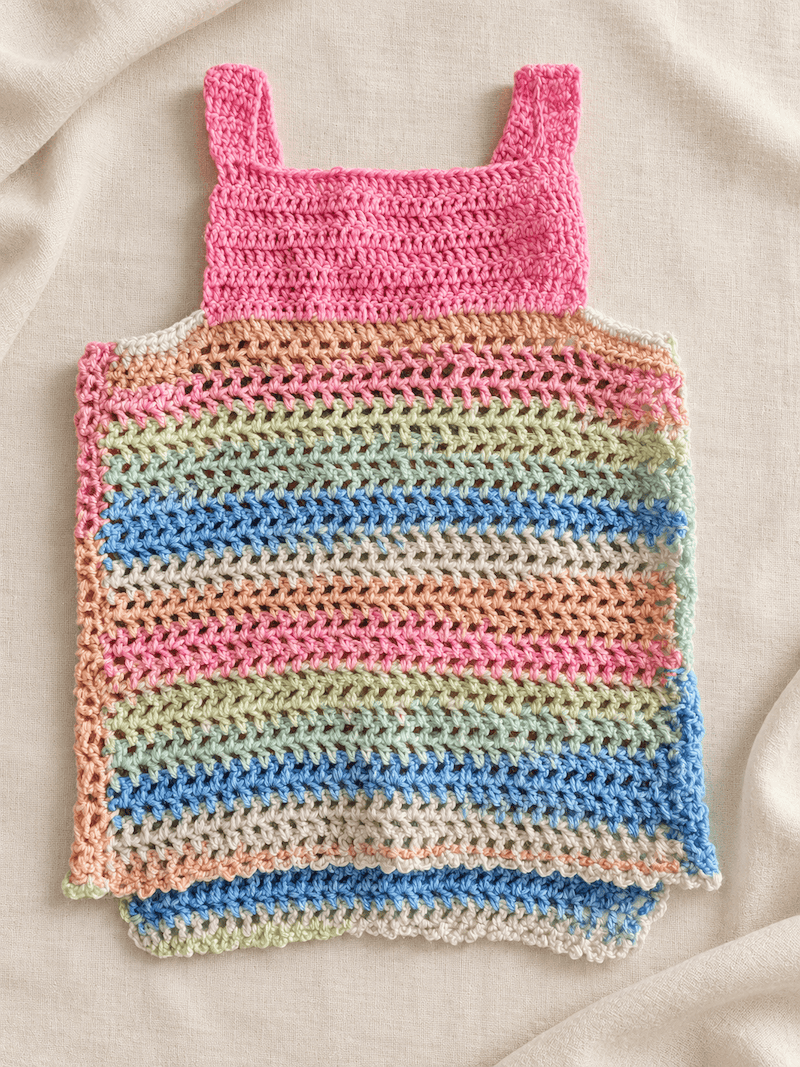
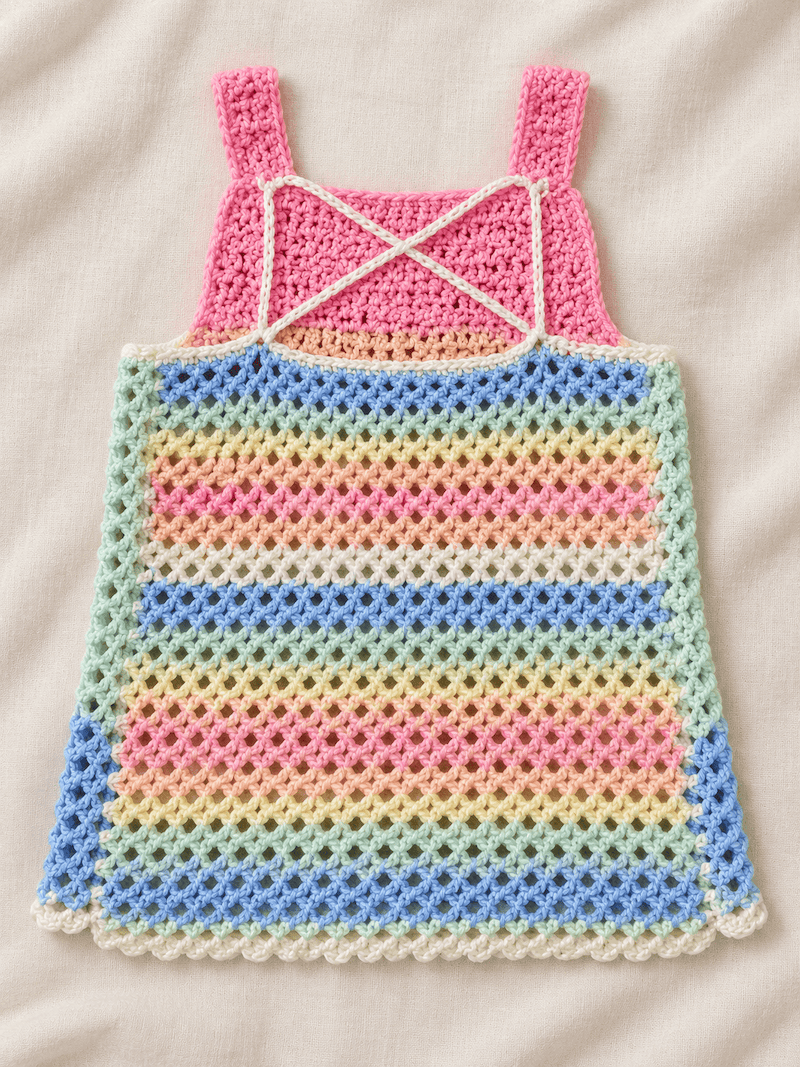
A little sundress for a little person: a solid pink bodice, an airy mesh skirt striped in six soft pastels, straps that cross at the back, and a scalloped hem. It is the lightest thing we have made all year, and the one we keep getting asked about.
Most crochet garments are warm. That is rather the point of them. This one is not. It is a pinafore for a toddler in the kind of weather where even a cotton t-shirt feels like too much, and it weighs almost nothing at all.
Meet our pastel pinafore: a bubblegum-pink bodice worked in a firm, close stitch, a skirt that is mostly air, and stripes in blue, mint, butter yellow, peach, pink, and cream that go round and round until they reach a scalloped hem.
Two fabrics in one dress
The trick with this dress is that the top and the bottom are made completely differently, on purpose.
- The bodice is solid. Rows of tight double crochet in a single pink, so it holds its shape, sits flat against the chest, and gives the straps something sturdy to hang from. Nothing here stretches or sags.
- The skirt is a mesh. Each row is a run of small V-stitches with a chain between them, which leaves a lattice of little diamond windows all the way down. It drapes, it swings, and it lets every breath of air straight through.
- The join between the two is a single round of cream, so the change from solid to open reads as a deliberate line rather than a mistake.
The pink at the top is the same pink that appears again as a stripe in the skirt, which is a small thing, but it is what makes the dress feel like one piece rather than two that happened to be sewn together.
The straps cross at the back
Turn it over and there is the part everyone smiles at. Two cream cords run from the top of the bodice down and across each other, ending at the corners of the skirt. They are a plain crochet chain, a little thicker than the yarn on its own, and they do two useful jobs.
The first is that they keep the shoulder straps from sliding off. Toddlers do not hold still, and a pinafore with straight straps ends up round the elbows by lunchtime. Crossed at the back, the straps stay where they were put.
The second is that they make the dress adjustable. Tie them a little tighter and it fits a one-year-old. Let them out and it will do for the same child next summer, with the mesh skirt sitting a touch shorter and looking none the worse for it.
Choosing the stripes
We used six colours, and none of them shout. That was the rule: every stripe had to be a colour you would find in a packet of sugared almonds.
- Two rows of one colour, then change. Always two, so the rhythm is even.
- Carry the yarn up the side rather than cutting it every time. The inside edge is a little busier for it, but there are almost no ends to weave in, and on a mesh that matters, because there is nowhere to hide them.
- Put the cream in the middle of the sequence, not at the ends. It gives the eye a place to rest halfway down.
The scalloped hem is the last round, worked in cream to match the join and the straps. Five double crochet into every other space, and the mesh finishes in a row of tiny shells instead of a hard line.
Who it is for
A child who runs. A summer wedding where the baby needs to look tidy for ten minutes and then be comfortable for six hours. A gift for a new parent who already has enough blankets.
For our students it is a lovely second garment. The bodice teaches you to work rows to a measurement and keep your edges straight. The skirt teaches the mesh stitch, which you will use again on shawls and market bags for the rest of your crochet life. The straps and the scallops teach you that finishing is where a project stops looking home-made and starts looking made at home.
It took three evenings, a single ball of each colour, and not one of them was finished. 🌸
Want to make one? Come and learn with us — we teach the mesh stitch in our second month.