24 September 2026
A Ganesha, Stitch by Stitch, as a Gift
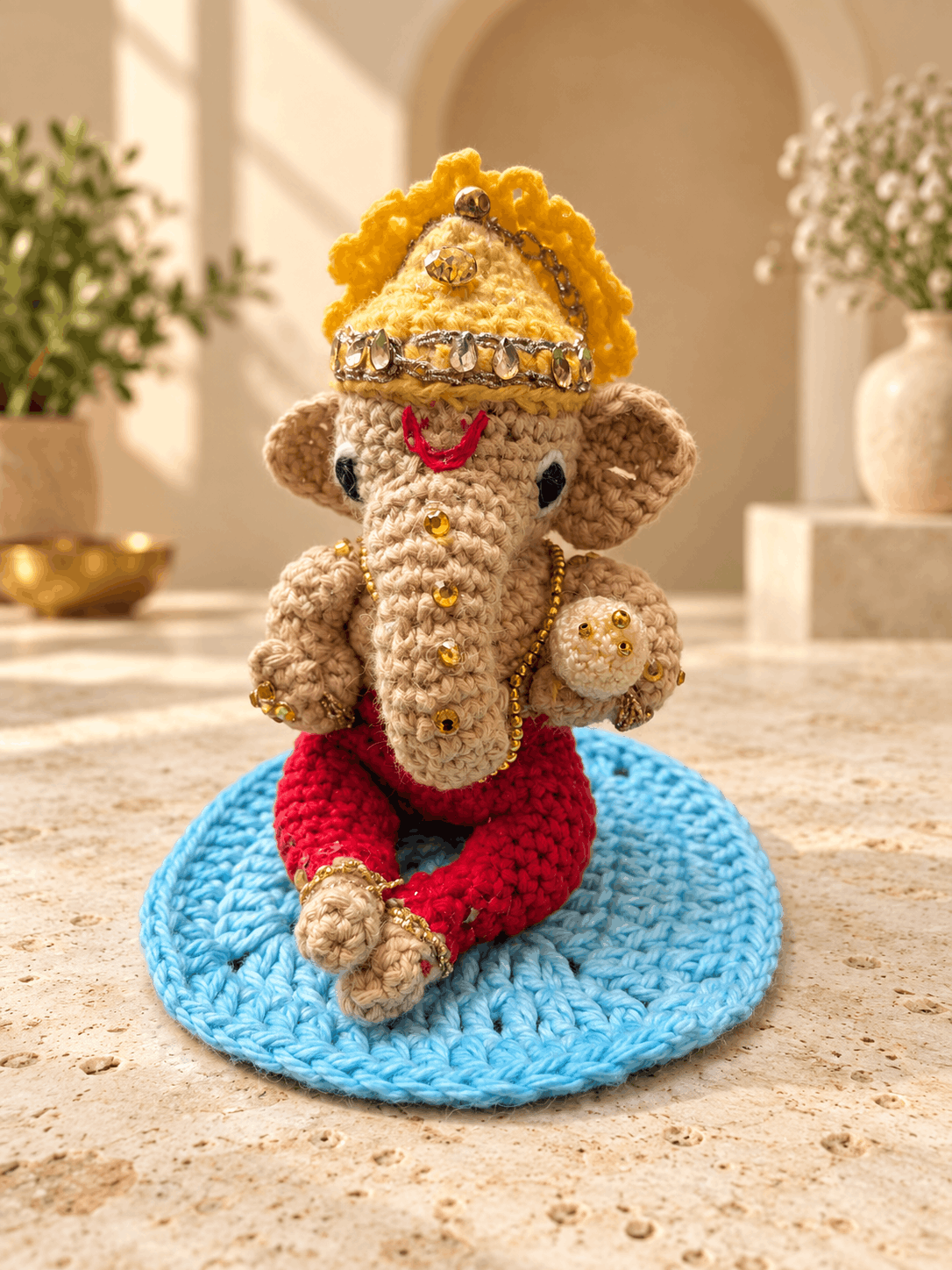
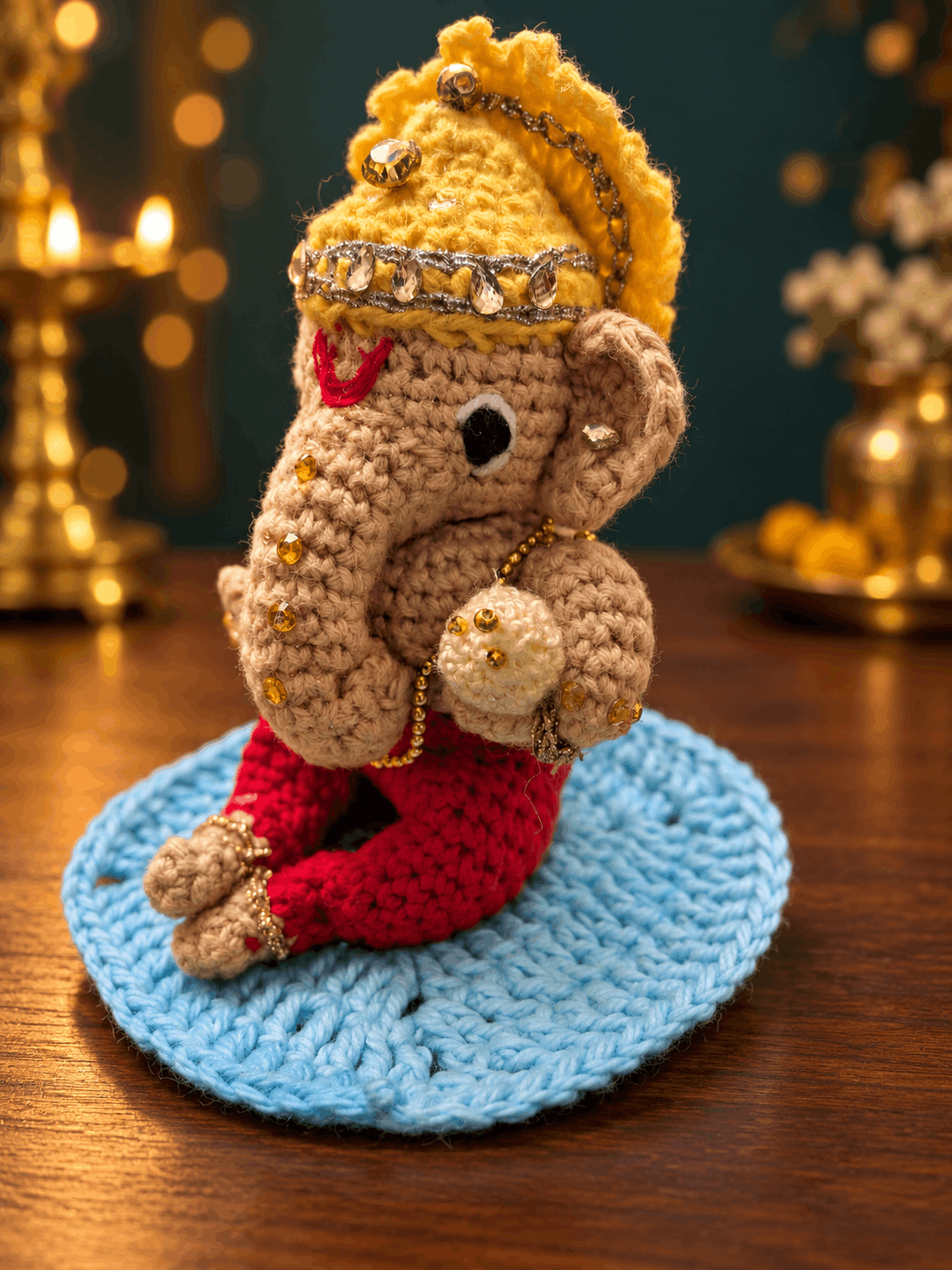
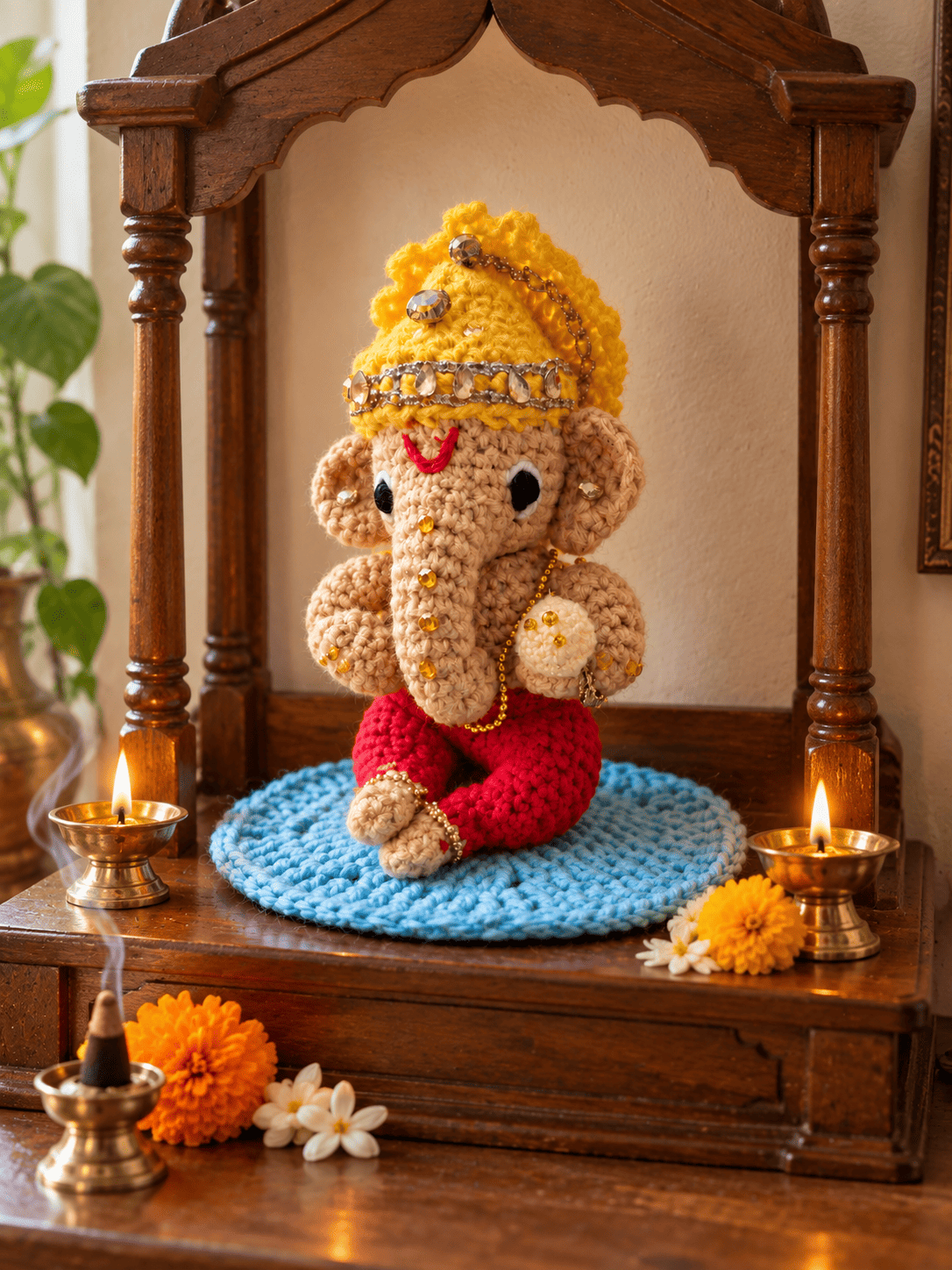
A little seated Ganesha in soft beige yarn, with a jewelled yellow crown, a red dhoti, a modak in his hand, and a sky-blue mat to sit on. We made him as a gift, and he is the most carefully finished piece to leave the studio this year.
Some makes are for the shelf and some are for the shop. This one was always going to be a gift, and that changed how we made every part of it.
Meet our crochet Ganesha: about the size of two cupped hands, seated cross-legged on a round blue mat, wearing a yellow crown set with stones, a red dhoti, a gold chain at his neck, and holding a single modak as though he has only just been handed it and is deciding when to eat it.
Beginning with the head
With an amigurumi elephant, the head is the whole piece. Everything else is there to hold it up. So we started there, in a warm beige cotton that reads as clay or sandalwood rather than grey.
- The head and trunk are worked as one. The trunk grows straight out of the face in continuous rounds, so there is no seam where it meets the forehead. It narrows as it goes and is stuffed lightly at the tip, which lets it curve gently to one side towards the modak.
- The ears are wide and flat. Two discs each, joined round the edge, so they stand away from the head and frame the face instead of drooping against it. We have written about this trick before, on our baby elephant.
- The eyes are ringed in white. A dark eye on its own disappears into beige yarn. A small white outline behind it makes the face look back at you from across a room.
- The tilak is embroidered. A red U in yarn on the forehead, stitched on last, once the head was stuffed and its shape settled. It is only three or four stitches, and it is the thing that turns an elephant into Ganesha.
The crown is two pieces
The crown is a cone of yellow, worked in the round and stuffed just enough to hold its point. Behind it sits a separate scalloped halo in a brighter yellow, a flat arch of shells that catches the light and gives the head a frame.
Then the finishing: a band of silver trim around the base set with teardrop stones, a larger stone at the tip and one at the centre, and a fine chain looped from one side of the crown to the other. None of it is crochet, and all of it is sewn on by hand, stitch through stitch, so nothing is glued and nothing will lift.
Jewellery, sewn one bead at a time
Look closely at the trunk and you will see a line of small gold sequins running down its length. There are more on the ears, on the hands, and on the modak itself. A gold bead chain hangs round his neck, and fine gold braid is wrapped at each wrist and ankle.
Our rule for embellishments on a gift piece is simple: sew, never stick. Glue yellows, and glued stones fall off in the first year. A sequin held with a bead and two passes of thread will outlast the yarn around it.
Sitting down properly
A seated figure is harder than a standing one, because the legs have to look relaxed while doing all the structural work.
- The legs are red tubes, stuffed firmly at the hip and softer towards the knee, then bent and sewn so they cross in front.
- The feet are beige, a colour change in the last few rounds, so they peep out at the ends like bare toes.
- The body is weighted at the base so he sits upright without leaning, and does not topple when someone picks up the mat to move him.
The mat itself is a plain circle of sky-blue double crochet, worked in the round with its increases stacked so they make faint spokes, like the petals of a lotus seen from above. It is the simplest part of the whole piece, and the one that makes it look finished rather than set down.
Why it had to be a gift
A crochet Ganesha is not a toy, and it is not quite decoration either. It is the kind of thing that goes on a shelf by the door, or beside the lamp in a puja corner, and stays there for years. That is why we made it slowly, and why every stone is sewn on rather than stuck.
For our students it brings together almost everything we teach: shaping in the round, colour changes, stuffing to a firmness that lasts, embroidery on the face, and the patient finishing that makes a handmade piece look intentional. It is not a first project. It is a very good tenth one.
He has gone to his new home now, and we already miss him a little. 🙏
Want to make one for someone you love? Come and learn with us — we will get you there, one round at a time.