24 September 2026
A Cream Scarf With Holes in It, on Purpose
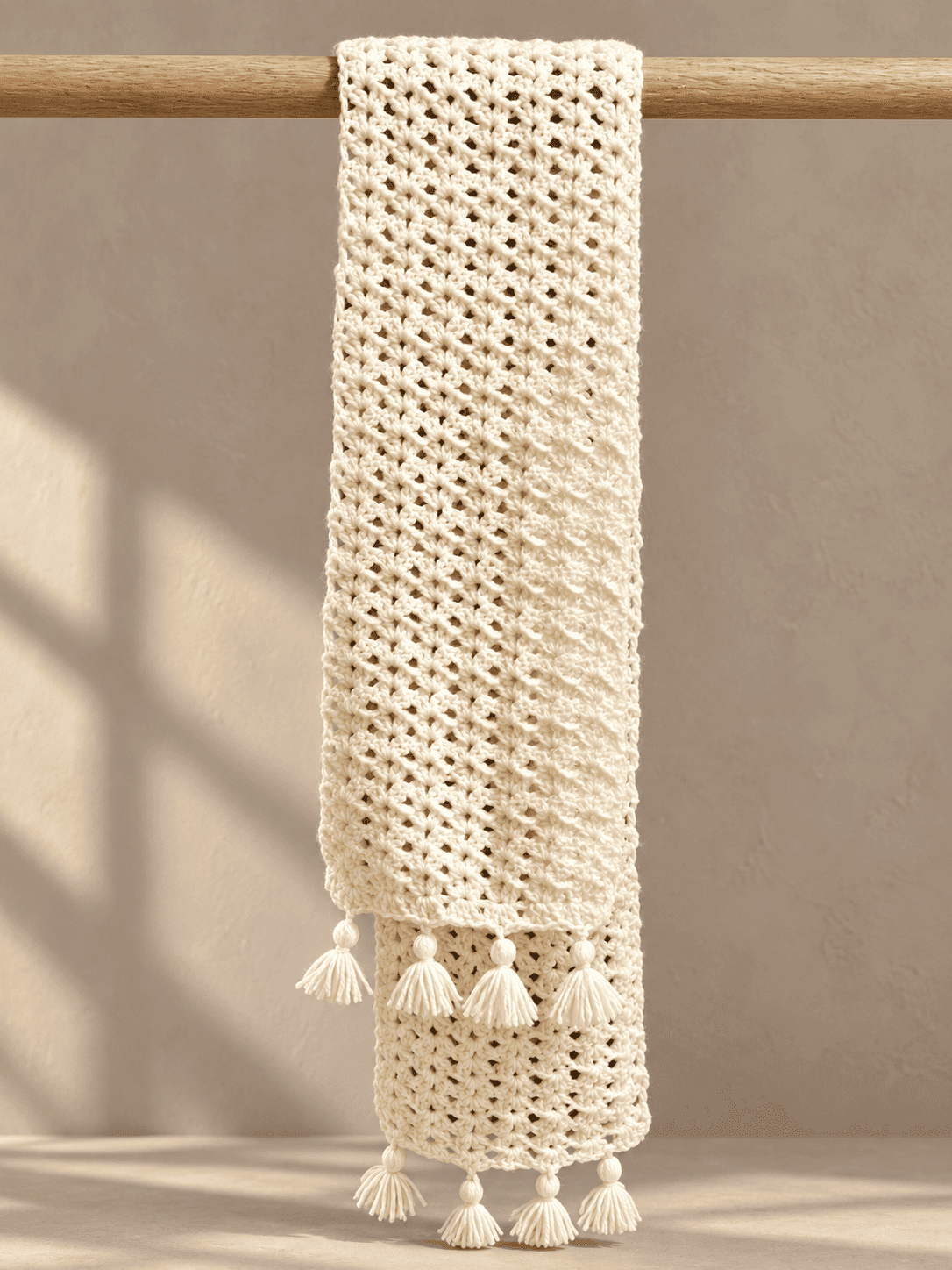
One colour, one stitch pattern, and eight little tassels: our open-lace scarf in soft cream is the simplest thing we have made in months, and it might be the most useful. Here is why a scarf full of holes still keeps you warm.
After weeks of crowns, sequins and six-colour stripes, we wanted to make something quiet. No colour changes, no stuffing, no beads to sew on. Just one ball of yarn after another, one stitch pattern repeated until it was long enough, and a tassel at each corner to finish it.
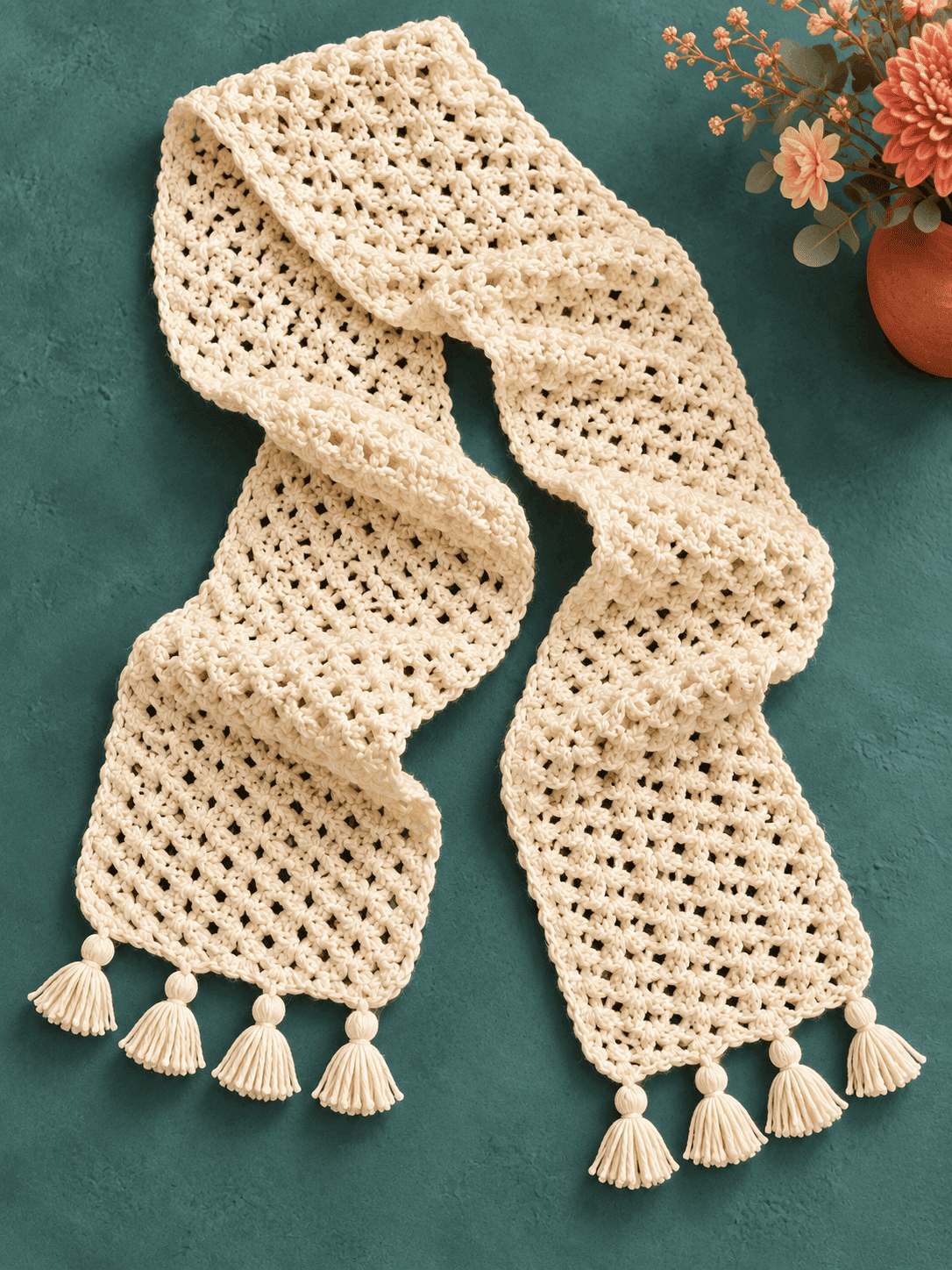
Meet our cream lace scarf: long, narrow, open as a trellis, and edged at both ends with four fat little tassels.
Why the holes
A scarf full of gaps sounds like a scarf that does not do its job. It is the other way round.
A solid crochet fabric is dense. Worked flat in rows of plain double crochet, a scarf this long turns into something closer to a blanket: heavy, stiff at the edges, and bulky when you wrap it twice. An open stitch uses less yarn per row, so the whole thing is lighter, and the fabric drapes and folds instead of standing up.
The warmth comes from the wrap, not the stitch. Once it goes twice round the neck, the holes in one layer sit over solid stitches in the next, and the air trapped between them does the rest.
One pattern, all the way down
The body of the scarf is a single lace repeat worked in rows:
- Small clusters of stitches, gathered into the same space so they fan out like tiny shells.
- A chain space between each cluster, which is what leaves the diamond-shaped windows.
- Each row offset by half a repeat, so every cluster sits in the gap left by the row below. That is what gives the fabric its diagonal texture when you look at it from a distance.
Once you have worked three or four rows, your hands know the rhythm and your eyes can go back to the television. It is exactly the kind of project you want in your bag for a long train journey.
Keep the edges straight
The one place a lace scarf gives itself away is at the sides. Open stitches pull in and push out more than solid ones, and a scarf that is a few stitches wider in the middle than at the ends looks home-made in the wrong way.
Two habits fix it:
- Count your repeats, not your stitches. At the end of every row, check that you have the same number of clusters. It is much quicker than counting every stitch, and it catches mistakes one row after you make them instead of twenty.
- Work the turning chain the same way every time. Most wobbly edges come from a turning chain that is one chain too long on some rows and one too short on others.
Tassels, not fringe
A fringe is the usual finish for a scarf, and we nearly did one. Then we tried a tassel on one corner and never went back.
Each tassel is a bundle of yarn wrapped round a card, tied at the top, and bound tightly a little way down to make a round head. Four on each end, spaced evenly across the width. They are heavier than a fringe, so they pull the ends of the scarf straight and stop them curling, and they swing when you walk, which is half the fun.
Make all eight tassels with the same card and wind them the same number of times. The eye forgives a lot, but it will spot one tassel that is fatter than its neighbours straight away.
A good first garment
For our students this is the project we suggest after the first dishcloth. It teaches you to read a stitch pattern, to count repeats, to keep edges straight over a long piece, and to finish something properly. And at the end of it you have something you will actually wear, in a colour that goes with everything you own.
It took a handful of evenings, and not one of them was spent concentrating. 🤍
Want to make one before the weather turns? Come and learn with us — lace stitches are easier than they look.